


Have you ever been gently petting your cat, enjoying a quiet moment together, when suddenly—ouch!—your cat gives you a little bite?
If this has happened to you, you’re definitely not alone.
Many cat owners have experienced the confusing situation where their loving, cuddly cat suddenly decides to use its teeth. One minute your cat is purring on your lap, and the next minute you’re wondering, “Why did my cats bite me?”
The good news is that when cats bite, it doesn’t always mean they are angry or dislike their owners. Cats use biting as one of many ways to communicate, play, explore their surroundings, or tell us that they’ve had enough.
Understanding why cats bite can help you build a better relationship with your feline companion and recognize when a bite is simply playful versus when it may be a sign of fear, stress, or discomfort.
Let’s look at 7 common reasons cats bite their owners.
Your Cat Is Playing :
One of the most common reasons cats bite is simply because they are playing.
Cats are natural hunters. Even a completely indoor cat has instincts that encourage it to chase, grab, pounce, and bite. When your cat is playing with a toy, your hand may sometimes become part of the game.
Kittens especially tend to bite while playing. They are learning important hunting and social skills, and biting is a normal part of how they interact with their siblings.
You might notice your cat:
-
- Chasing your hands or feet
-
- Jumping toward you suddenly
-
- Grabbing your hand with its paws
-
- Biting gently and then running away
-
- Kicking with its back legs during play
This type of biting is usually accompanied by energetic body language rather than fear or aggression.
What should you do?
Avoid using your hands or feet as toys. Instead, give your cat appropriate toys such as feather wands, balls, or interactive toys.
This teaches your cat an important lesson: toys are for biting, hands are for affection.
Your Cat Has Had Enough Petting :
Have you ever noticed that your cat enjoys being petted for a few minutes and then suddenly bites?
This is often called petting-induced overstimulation.
Cats have different tolerance levels when it comes to physical contact. Some cats could happily sit on your lap for an hour, while others enjoy only a few minutes of petting before they need a break.
Your cat may give you warning signs before it bites.
Look for:
-
- A rapidly moving or twitching tail
-
- Ears turning sideways or backward
-
- Skin twitching along the back
-
- Suddenly looking toward your hand
-
- Tensing the body
-
- Trying to move away
If you continue petting after these signals, your cat may eventually use a bite to say, “Okay, that’s enough.”
The best approach is to pay attention to your cat’s body language and stop before it becomes uncomfortable.
Learning these small signals can make a huge difference in your relationship.
Your Cat Is Showing Affection :
This one can be confusing.
Sometimes cats bite gently as part of affectionate behavior.
You may have heard people describe these as “love bites.” A gentle nibble during cuddling or grooming-like behavior may not be intended as aggression.
For example, your cat may:
-
- Lick your hand
-
- Rub its face against you
-
- Purr
-
- Sit close to you
-
- Give you a gentle nibble
If your cat is relaxed and the bite is gentle, it may simply be part of its social interaction with you.
However, every cat is different. A bite that seems gentle to one person may still be uncomfortable or painful.
Never assume that every bite is an expression of affection. Always consider the cat’s overall body language and the situati

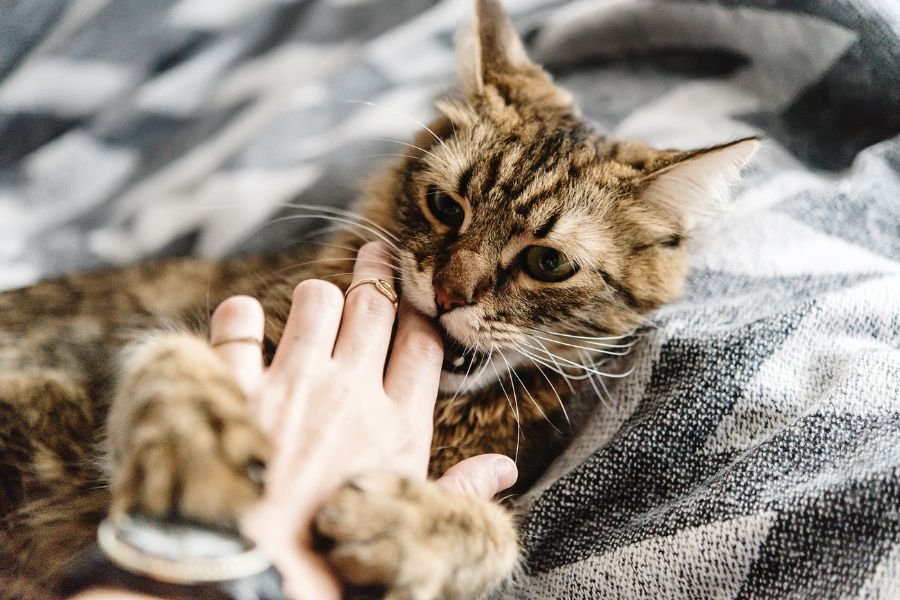
Your Cat Is Trying to Get Your Attention :
Cats are clever animals, and they quickly learn which behaviors get a response from their humans.
If your cat discovers that a little bite makes you look at it, talk to it, or get up from your chair, it may repeat the behavior.
Your cat might bite because it wants:
-
- Food
-
- Playtime
-
- Attention
-
- Access to another room
-
- A favorite toy
-
- Interaction with you
For example, imagine you’re working at your desk and your cat gently bites your arm. You immediately stop working and start playing with it.
From your cat’s perspective, the lesson may be simple:
“Biting gets my human’s attention.”
Instead of rewarding the behavior, try to understand what your cat is actually asking for.
If it wants playtime, offer an appropriate toy. If it’s hungry, maintain a consistent feeding routine. If it simply wants companionship, give it attention when it is calm rather than immediately after biting.
Your Cat Is Scared or Stressed :
Fear is another important reason cats bite.
A frightened cat may bite because it feels threatened and believes it needs to protect itself.
Situations that can make cats nervous include:
-
- Loud noises
-
- Unfamiliar visitors
-
- Other animals
-
- Moving to a new home
-
- Being picked up unexpectedly
-
- Visits to the veterinarian
-
- Sudden movements
-
- Being cornered
A fearful cat may show obvious warning signs before biting.
Its ears may flatten against its head. Its body may become tense. It may hiss, growl, hide, or try to escape.
If you see these signs, give your cat space.
Do not chase, corner, or force interaction with a frightened cat. Allow it to move somewhere quiet and safe.
A calm environment can help your cat regain confidence.
Your Cat May Be Experiencing Pain :
Sometimes a cat bites because something hurts.
This is particularly important if your cat suddenly starts biting when it previously did not.
Imagine that you gently touch your cat’s back and it suddenly turns around and bites your hand. It may not be trying to be aggressive. It could be reacting to pain in that area.
Pain-related biting can be associated with problems such as injuries, dental issues, arthritis, skin conditions, or other health concerns.
Pay attention to other changes in behavior, including:
-
- Hiding more than usual
-
- Eating less
-
- Sleeping much more or much less
-
- Avoiding jumping
-
- Limping
-
- Excessive grooming
-
- Changes in litter box habits
-
- Becoming unusually irritable
If your cat’s behavior changes suddenly or you suspect it is experiencing pain, contact a veterinarian.
A sudden change in behavior deserves attention, especially when it is unusual for your individu
Your Cat Is Communicating a Boundary
Sometimes a bite is simply your cat’s way of saying “stop.”
Cats cannot use words to tell us when they don’t like something. Instead, they rely on body language and behavior.
Your cat may be communicating that it doesn’t want to:
-
- Be picked up
-
- Have its belly touched
-
- Have its paws handled
-
- Continue being petted
-
- Be disturbed while sleeping
-
- Be approached while eating
Every cat has its own personality and boundaries.
Some cats love belly rubs. Others absolutely do not.
Some cats enjoy being carried around. Others prefer all four paws firmly on the ground.
Respecting these individual preferences helps build trust.
When your cat learns that you listen to its signals, it has less reason to escalate those signals into a bite.

How to Tell the Difference Between Play Biting and Aggressive Biting
Not every bite means the same thing.
Understanding the context can help you figure out what your cat is trying to communicate.
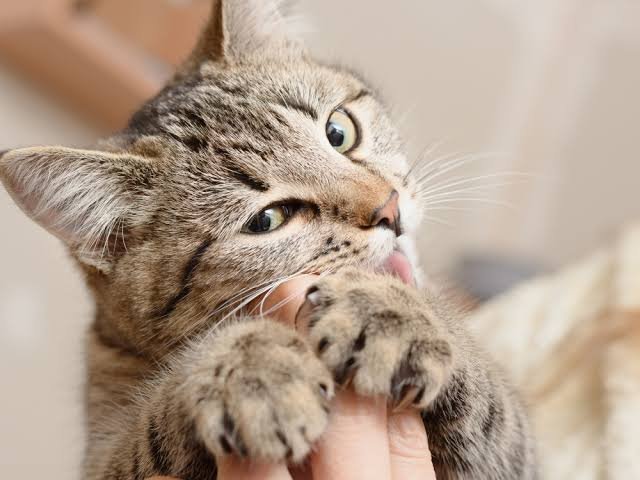
Playful biting may include:
-
- Relaxed or energetic body language
-
- Chasing and pouncing
-
- Gentle grabbing
-
- Playing with toys at the same time
-
- No obvious signs of fear
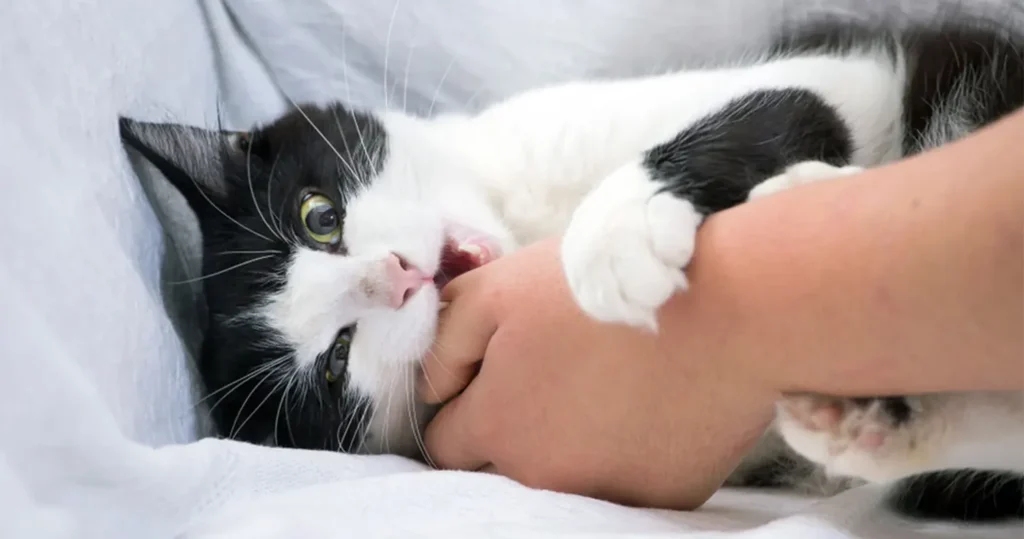
Defensive or fearful biting may include:
-
- Hissing
-
- Growling
-
- Flattened ears
-
- Arched or tense body
-
- Tail tucked or puffed up
-
- Attempting to escape
-
- Repeated biting
Remember that individual cats behave differently, so these signs should be considered together rather than as a strict checklist.
What Should You Do When Your Cats Bite You?
Your first reaction might be to pull your hand away quickly or yell.
Try not to punish your cat.
Physical punishment can increase fear and stress and may make the biting behavior worse.
Instead:
1. Stay calm
Avoid shouting or hitting your cat.
2. Stop the interaction
If your cat bites during petting, calmly stop touching it.
3. Give your cat some space
Allow your cat to move away if it wants to.
4. Redirect playful behavior
If your cat wants to bite during play, offer a toy instead of your hands.
5. Learn its warning signals
Over time, you’ll begin to recognize when your cat is becoming uncomfortable.
6. Consider professional help when necessary
If biting is frequent, severe, unpredictable, or suddenly begins, talk to your veterinarian. A qualified animal behavior professional may also be helpful.

How Can You Stop Your Cat From Biting?
Preventing bites is usually easier than trying to correct the behavior afterward.
Start by observing your cat carefully.
If you notice that your cat always bites after several minutes of petting, shorten the petting session.
If your cat bites during energetic play, use toys instead of hands.
If your cat becomes nervous around visitors, provide a quiet room or safe hiding place.
And if your cat bites when touched in a particular area, don’t ignore the possibility of pain.
The goal isn’t simply to stop the bite. The goal is to understand why your cat is biting in the first place.
Once you understand the reason, the solution often becomes much clearer.
Why Do Cats Bite Their Owners but Still Love Them?
This is one of the questions many cat owners ask.
A cat can trust you, enjoy spending time with you, and still bite you occasionally.
Cats aren’t perfect little machines programmed to behave in predictable ways. They have moods, preferences, instincts, fears, and individual personalities.
Your cat might love sitting beside you but dislike being picked up.
It might enjoy playing with you but become overstimulated during petting.
It might sleep next to you every night but still tell you to stop touching it when it has had enough.
These contradictions are part of what makes living with cats so interesting.
The key is learning to respect your cat’s communication.
why do cats bite their owners?
There isn’t one simple answer.
Cats bite because they may be playing, feeling overstimulated, seeking attention, showing affection, feeling frightened, communicating a boundary, or experiencing pain.
The most important thing is to look beyond the bite itself.
Ask yourself:
What was happening immediately before the bite?
Was your cat playing? Were you petting it? Was there a loud noise? Did you touch a particular area? Was your cat trying to get your attention?
These details can reveal what your cat is actually trying to communicate.
The more you understand your cat’s body language, the easier it becomes to recognize its boundaries and needs.
And remember, a bite doesn’t automatically mean your cat doesn’t love you.
Sometimes, your cat is simply saying something in the only language it has.
Our job as cat parents is to learn how to listen.